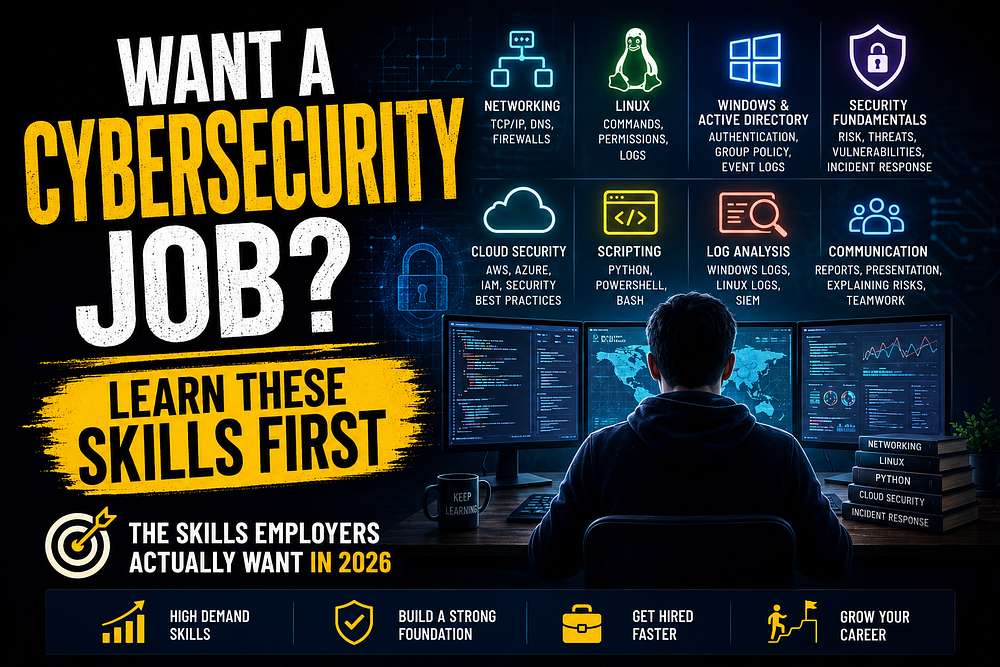
Most employers weren’t looking for elite hackers. They were looking for strong fundamentals, practical skills, and people who can solve problems.
If you’ve spent any time exploring cybersecurity careers online, you’ve probably seen conflicting advice.
One person says you need five certifications.
Another says you need to learn ethical hacking.
Someone else claims you need a computer science degree.
As a result, many aspiring cybersecurity professionals spend months learning random tools without understanding what employers actually want.
To find out what skills consistently appear in cybersecurity job descriptions, I reviewed dozens of listings for roles such as:
SOC Analyst
Cybersecurity Analyst
Security Engineer
Incident Response Analyst
Cloud Security Analyst
Junior Security Consultant
What surprised me was that most employers weren’t asking for advanced hacking skills.
Instead, they kept asking for the same core fundamentals.
Let’s look at the skills that appeared again and again.
1. Networking Knowledge
If there is one skill that shows up almost everywhere, it’s networking.
Cybersecurity professionals are expected to understand how systems communicate.
Common topics include:
TCP/IP
DNS
HTTP and HTTPS
VPNs
Firewalls
Routing and Switching
Think about it this way:
You can’t secure a network if you don’t understand how it works.
Many security incidents involve network traffic, suspicious connections, or misconfigured services.
Networking is the foundation upon which many cybersecurity skills are built.
2. Linux Skills
Linux appeared in a large percentage of job postings.
Why?
Because Linux powers:
Cloud infrastructure
Web servers
Security tools
Enterprise systems
You don’t need to become a Linux expert overnight.
Start with:
Navigating directories
Managing files
Understanding permissions
Viewing logs
Basic terminal commands
Being comfortable in a Linux environment immediately makes you more valuable.
3. Windows and Active Directory
While Linux is important, many organizations still rely heavily on Windows environments.
Employers frequently mention:
Active Directory
Group Policy
User Management
Authentication
Windows Event Logs
Many cyberattacks target Active Directory because it plays a central role in enterprise networks.
Understanding how Windows environments work is a major advantage.
4. Security Fundamentals
One of the biggest mistakes beginners make is jumping directly into hacking tools without learning security basics.
Employers repeatedly look for knowledge of:
CIA Triad
Risk Management
Vulnerability Management
Security Controls
Incident Response
Threat Detection
These concepts help you understand why security measures exist and how organizations manage risk.
Strong fundamentals never go out of style.
5. Cloud Security
Cloud security is becoming one of the fastest-growing areas in cybersecurity.
Many job listings mention:
AWS
Microsoft Azure
Google Cloud
Identity and Access Management (IAM)
Cloud Security Best Practices
As more companies move to the cloud, professionals who understand cloud environments become increasingly valuable.
Even basic cloud knowledge can help your resume stand out.
6. Scripting and Automation
Good news:
Most employers are not expecting entry-level candidates to be software developers.
However, basic scripting skills are highly valued.
Common languages include:
Python
PowerShell
Bash
Scripting helps automate repetitive tasks such as:
Log analysis
Data collection
Security checks
Report generation
Even beginner-level scripting can save significant time and improve efficiency.
7. Security Tools
Many job descriptions mention security tools.
Common examples include:
Wireshark
Nmap
Burp Suite
Splunk
Microsoft Defender
SIEM Platforms
The goal isn’t memorizing every feature.
Employers want candidates who understand:
What the tool does
When to use it
What problems it solves
Practical experience matters more than tool memorization.
8. Log Analysis
Cybersecurity professionals spend a surprising amount of time reviewing logs.
Logs help answer critical questions:
What happened?
When did it happen?
Who was involved?
Was the activity malicious?
Useful log sources include:
Windows Event Logs
Linux Logs
Web Server Logs
Firewall Logs
Authentication Logs
The ability to investigate logs is one of the most valuable skills for analysts.
9. Communication Skills
This skill appears less often in job descriptions but is highly valued by employers.
Cybersecurity professionals regularly:
Write reports
Explain findings
Present risks
Work with non-technical teams
The ability to clearly communicate technical information is often what separates good professionals from great ones.
You can be highly technical, but if you can’t explain a problem, your impact is limited.
10. Problem-Solving Ability
Many employers specifically look for candidates who can think critically.
Cybersecurity is rarely about following a script.
You’ll encounter situations where:
Information is incomplete
Alerts are confusing
Multiple explanations are possible
Strong problem-solvers can investigate issues, connect clues, and make informed decisions.
This skill becomes more important as you progress in your career.
What Employers Seem to Care Less About
Many beginners spend months focusing on:
Kali Linux
Metasploit
Advanced exploitation
Ethical hacking tools
While these skills can be useful, they appeared far less frequently than expected in many entry-level job listings.
Employers often prioritize:
Networking
Operating systems
Troubleshooting
Security fundamentals
In other words:
The basics matter more than flashy tools.
A Practical Learning Roadmap
If you’re starting from scratch, consider focusing on skills in this order:
Step 1
Learn Networking
Step 2
Learn Linux Basics
Step 3
Learn Windows and Active Directory
Step 4
Study Security Fundamentals
Step 5
Learn Basic Python
Step 6
Explore Cloud Platforms
Step 7
Practice with Security Tools
Step 8
Build Home Lab Projects
Step 9
Consider Certifications
Step 10
Apply for Internships and Entry-Level Roles
This approach builds a strong foundation that aligns with what many employers are actually looking for.
The Biggest Lesson
The cybersecurity industry often looks intimidating from the outside.
Job descriptions mention dozens of technologies, certifications, and tools.
But after reviewing numerous cybersecurity roles, one pattern became clear:
Most employers aren’t looking for elite hackers.
They’re looking for people who understand the fundamentals, can solve problems, and are willing to keep learning.
Technology will change.
Tools will change.
Threats will change.
Strong fundamentals will remain valuable throughout your career.
Final Thoughts
If you’re trying to break into cybersecurity, don’t get distracted by every new tool, certification, or trend.
Focus on building a solid foundation in networking, operating systems, security concepts, cloud technologies, and communication.
These are the skills that consistently appear in cybersecurity job listings.
And more importantly, they’re the skills that will help you succeed long after you land your first cybersecurity job.
The goal isn’t to learn everything.
The goal is to learn the right things first.
No comments yet.