The Cyberattack Nobody Saw Coming
When people think about hackers, they often imagine someone breaking into a company’s systems using advanced techniques.
But one of the biggest retail hacks in history started with something much simpler:
An HVAC company.
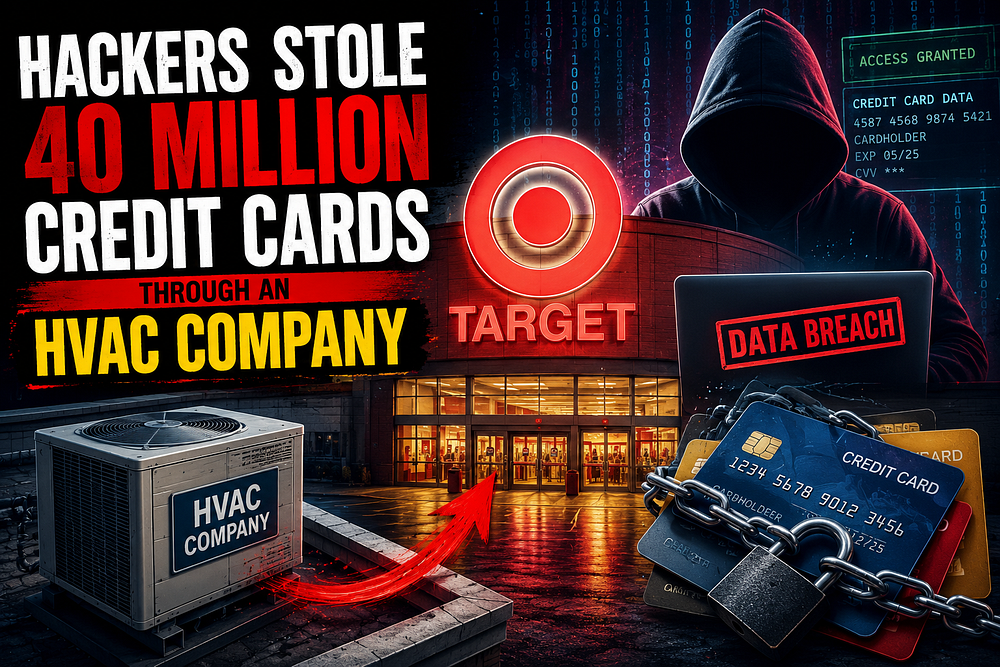
In 2013, hackers stole credit card information from about 40 million Target customers. Surprisingly, they didn’t start by attacking Target directly. Instead, they first hacked a small company that provided heating and air-conditioning services to Target stores.
This attack changed how companies think about cybersecurity and third-party vendors.
The Small Company Behind a Massive Breach
The company was called Fazio Mechanical Services, an HVAC contractor that worked with Target.
Like many vendors, Fazio had access to some Target systems for business purposes such as:
Sending invoices
Managing contracts
Monitoring store equipment
Because of this business relationship, Target trusted the company.
Hackers knew that attacking a smaller company would be easier than attacking Target directly.
How the Attack Started
The hackers first infected the HVAC company’s computers with malware.
This malware stole login credentials used to access Target’s vendor portal.
Once the attackers had those credentials, they could enter Target’s network as if they were a legitimate vendor.
No alarms were triggered because the login appeared normal.
Getting Deeper Into Target’s Network
Getting into the vendor portal wasn’t enough.
The attackers wanted access to Target’s payment systems.
They spent time exploring the network and moving from one system to another until they reached computers connected to cash registers and payment terminals.
This process is called lateral movement.
The Malware on Cash Registers
After reaching the payment systems, the attackers installed malware on Target’s point-of-sale (POS) terminals.
These are the systems that process customer payments at checkout counters.
Whenever a customer swiped a credit card, the malware secretly copied the card information before it was encrypted.
Customers had no idea it was happening.
What Information Was Stolen?
The malware collected:
Credit card numbers
Debit card numbers
Expiration dates
Other payment-related information
Because the attack happened during the busy holiday shopping season, millions of cards were exposed.
The Damage
The final impact was huge:
Around 40 million payment cards stolen
Personal information of about 70 million customers exposed
Hundreds of millions of dollars in costs for Target
Serious damage to the company’s reputation
The breach became international news and remains one of the most famous cyberattacks ever.
Why Was This Attack Successful?
1. Trusted Vendor Access
The attackers used a company that Target already trusted.
Instead of breaking in directly, they used someone else’s access.
2. Too Much Network Access
Once inside, the attackers were able to move through Target’s network and reach important systems.
Better network separation could have made this much harder.
3. Security Warnings Were Missed
Reports later showed that some security tools detected suspicious activity.
Unfortunately, the warnings were not acted on quickly enough.
Lessons for Every Business
Your Vendors Matter
A company’s security is only as strong as its weakest partner.
Give Limited Access
Vendors should only have access to the systems they truly need.
Monitor Your Network
Security alerts should be investigated immediately.
Use Zero Trust Principles
Never automatically trust users, devices, or vendors simply because they are already connected.
Why This Story Still Matters Today
More than ten years later, hackers still use similar methods.
Instead of attacking large companies directly, they often target:
Vendors
Suppliers
Contractors
Service providers
These organizations may have weaker security but still provide access to valuable targets.
Conclusion
The Target breach taught the cybersecurity world an important lesson:
Hackers don’t always attack the biggest company directly.
They look for the easiest way in.
In this case, that path was through a small HVAC company that had access to Target’s systems.
A trusted vendor became the entry point, and millions of customers were affected.
That’s why modern cybersecurity isn’t just about protecting your own network — it’s also about securing everyone connected to it.
No comments yet.